Hawthorn (Crataegus monogyna)
Identification
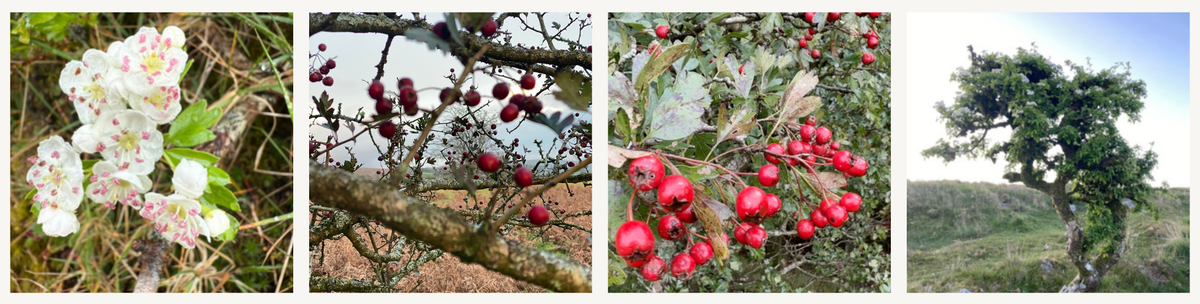
A small tree with thorns, white flowers, and pink anthers. Annual fruit, haws, are red berries. Flowers share a smelly chemical, trimethylamine, with that of decaying flesh.
Botany
Hawthorns will grow hundreds of years but, seeds take two winters to germinate. Leaves are edible.
Lore
Seen as both a protective and dangerous tree; the May tree was once a central part of the spring festivities. It symbolises rebirth and fertility; but also evokes death. Also known as pixie pears, due to the haws, the hawthorn tree is thought to be a spiritual tree of the faeries.
How to make haw (hawthorn berry) ink
The windswept hawthorns on top of the stone wall on the way to the workshop are too tall for me to reach, and often have only a few haws. They are, however, a good indicator of when it might be time to look for my favourite collection trees. One is in the horse paddock next to the bathtub, the other is the other side of an old stone wall that has long been too short to make itself useful. You too will likely have trees that tell time, and trees that are good for harvest. Don't stop at the first tree, get to know your neighbourhood and the options it offers.
Colours
The haws (berries) give an excellent range of colours, depending on whether they are cooked in acidic or alkaline water: red, orange, green, salmon, grey, purple.
Cooking
Most of the instructions I’ve seen recommend separating the haws from the woody material. This is tedious, so I don’t bother.
- Put the haws in a saucepan and cover with water (see notes about colour modification).
- Bring water to a boil then immediately reduce heat and simmer for 20 minutes.
- Strain out plant material. Reduce water by half.
- Add gum Arabic to suit.
You can usually cook the haws two or three times before the colour is completely exhausted. The sludge and pits can be disposed of in your compost.
Modifying
Choose one cooking modifier.
- Light green: Add 1tbsp cooking alum to cooking water.
- Orange: Add 1/2 tbsp baking soda to cooking water. Orange can be difficult to achieve in drought years.
- Red: Add 1-2 tbsp baking soda.
Post-cooking modifications
- Black and greys: add iron II sulphate to the finished ink.
- Purple: To the black/grey ink: add baking soda.
- Salmon/pinks: add tin to the ink prepared in baking soda.
Ink-terested?
We love Wild Colour and making inks from plants we've foraged on Dartmoor. Are you interested in botanical ink, too? Sign up to our monthly newsletter, and we'll send you a free recipe you can use to make your own at home.