Hyper-local history: Dartmoor's pollen record
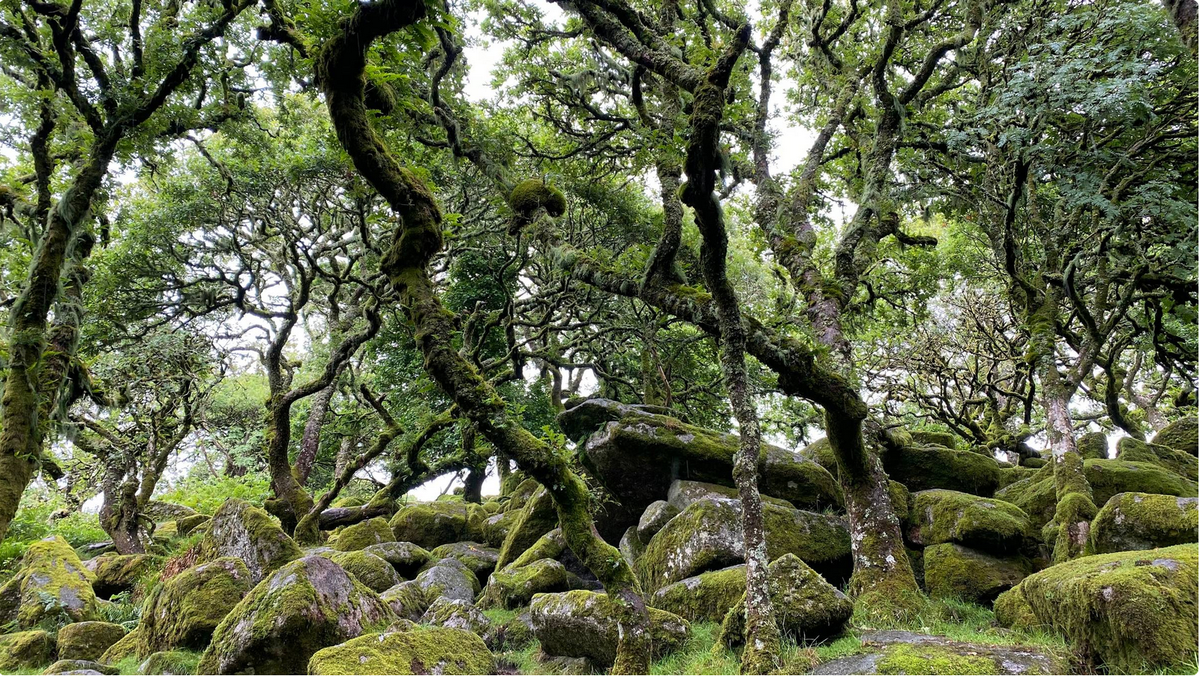
If you've been to Princetown, you no doubt will have travelled through many habitats to arrive in the village: lowland farms, valley forests, and the bleak high moor. If we were to take a sample from each of these places, they would have slightly different contemporary pollen assemblages. Hold that in mind. Of course, we shouldn't be surprised that there are variations in the pollen record between places; however, ecologists from the 1960s and earlier, would sometimes take a single study and assume that the rest of the surrounding land had the same plants. Sometimes, the scientists would even make assumptions about what happened on Dartmoor several thousand years ago based on the other moorlands in the UK. When there isn't a lot of information, this process of hypothesising and extrapolating, makes sense...and also makes mistakes.
Contemporary science has the benefit of more research, more sophisticated processing methods, and better tooling (such as radiocarbon dating to get actual dates for pollen records). Each of the pollen studies that have been conducted on Dartmoor can only tell us what happened at that location. A core from Black Ridge Brook tells you what happened at Black Ridge Brook. Nothing more.
Let's look at a couple of examples.
Tin gullies and rowan trees
Not a single waterway on Dartmoor has escaped human intervention -- it is an anthropogenic landscape. On my dailyish walks around Princetown, I pass by many deep gullies that were shaped by tin miners hundreds of years ago. The gullies often have stacks of loose stones at their base. On the sides of the gullies, there is often one or two lone rowan trees. These trees like well-drained, acidic soils, and can tolerate living amongst the rocks. The steep sides can protect the trees from grazing, although the slopes are often well grazed as the gullies provide protection from the fierce winter winds. It is impossible to know the lineage of these trees, but we do know they enjoy the habitat created by our industrial heritage. When we forage on the high moor, the trees tell us where the tinners worked. History highlighted by rowan.
Willow and alder; water and place
Willow loves water. It thrives in water-soaked soils, and it's often found along rivers and in wet areas. Today, the willows I know from my daily walk are mostly located alongside small streams that will later turn into the major rivers of Dartmoor. Sometimes, the streams are so small they are more like slow moving bogs at the head of a river. Alder once did the same – colonising stream sides and bog margins on the high moor. It took nearly 1,500 years for alder to become established across on Dartmoor (beginning 7000 years ago). We believe alder was finally cleared by the tin miners in search of firewood some 800 years ago. Today, I know of only one alder near Princetown. It lives alongside a stream, excluded from grazing by a fence, perhaps planted intentionally. Across the seasons, we are slowly collecting tannin-rich catkins for ink. It may take years before we have enough to make ink.